


1988 Range Rover Classic
March 22, 2026
1964 Mustang
March 23, 2026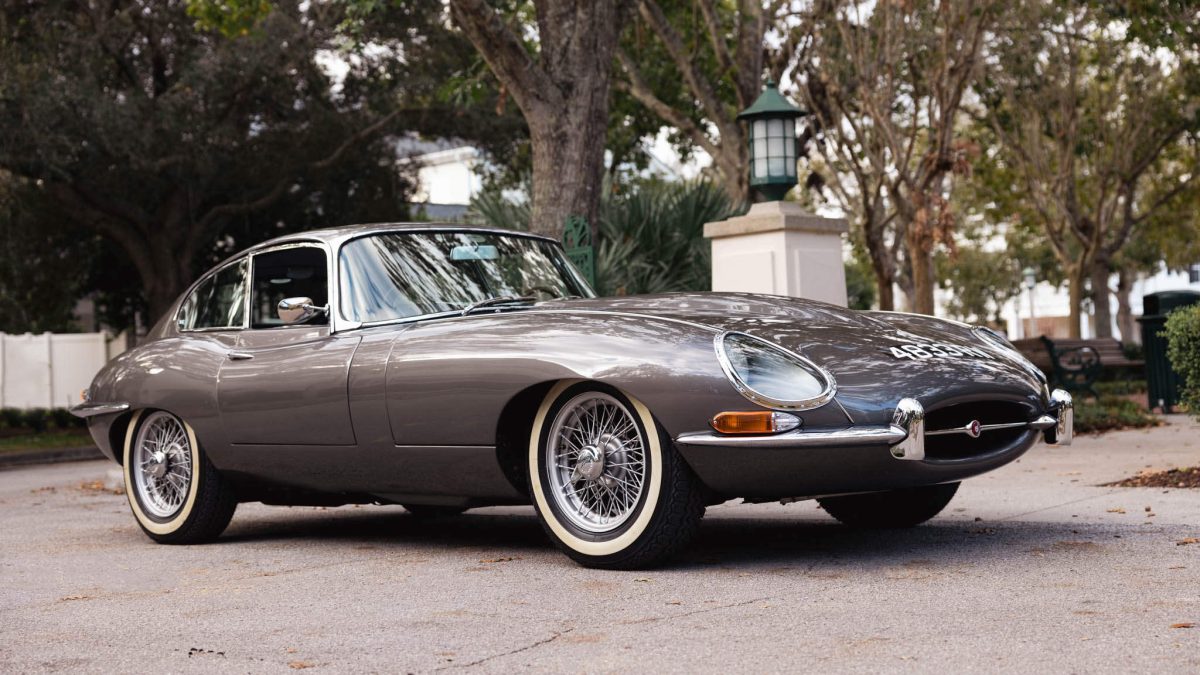
Where the 1970 Fits in the E-Type Story
By 1970, the Jaguar E-Type was nine years into its production run and had already been through one significant transformation. The Series I had ended in 1968, reshaped by incoming U.S. safety and emissions regulations that forced Jaguar to make visible changes to the car. What emerged was the Series II — and the 1970 model sits squarely in the middle of that generation, representing the Series II at its most developed and refined.
For collectors and enthusiasts researching this specific era, the 1970 E-Type is a Series II in its fullest form: the exposed headlights, the enlarged front intake, the repositioned taillights, and the compliance-driven interior updates were all in place and settled. It is a different car from the glass-covered Series I, and it deserves to be understood on its own terms.
What Changed Between Series I and the 1970 Series II
The shift from Series I to Series II was not driven by Jaguar’s design department. It was driven by legislation — specifically the U.S. National Traffic and Motor Vehicle Safety Act and tightening emissions standards that the American market, Jaguar’s most important export destination, was enforcing through the late 1960s.
The most immediately visible change was the headlights. The glass-covered units that defined the Series I look were removed entirely. Open headlights, mounted in a more prominent position, replaced them. This is the single easiest way to identify a Series II at a glance, and it remains the most discussed styling difference among enthusiasts.
The front intake was enlarged substantially to improve cooling capacity, which had become a concern as emissions equipment added heat load to the engine bay. Taillights moved below the bumper line rather than sitting above it, and the bumpers themselves grew to meet new impact standards. Inside, head restraints appeared, the steering column became collapsible, and a steering lock was added.
None of these changes were what Jaguar would have chosen purely on aesthetic grounds. But the Series II is not a lesser car for them. It is an E-Type adapted to survive in a regulatory environment that was reshaping the entire global sports car market, and it did so without losing the fundamental character that made the design matter in the first place.
The 1970 E-Type: Specs and Character
The engine in the 1970 E-Type is the 4.2-liter inline-six — the same displacement that Jaguar introduced in late 1964 to replace the original 3.8. By 1970 this engine was well-developed and well-understood. It produced approximately 265 horsepower in standard tune, with strong torque characteristics that made it genuinely enjoyable to drive rather than just fast on a spec sheet.
Transmission options included a four-speed manual gearbox with full synchromesh on all gears — a significant improvement over the early Moss gearbox of the first Series I cars, which had no synchromesh on first gear. A Borg-Warner automatic was also available for the U.S. market, reflecting Jaguar’s awareness of American buyer preferences.
The 1970 model retained the independent rear suspension that had made the E-Type’s handling so impressive at launch. Four-wheel disc brakes, also from the original design, remained in place. The fundamental engineering that had set the E-Type apart in 1961 was still there in 1970, underneath the revised bodywork.
Body styles available in 1970 were the roadster (open two-seater) and the 2+2 coupe, which offered a slightly longer wheelbase and rear seating suitable for occasional use. The fixed-head coupe that had been part of the original lineup was discontinued with the Series II.
Series II vs Series I: The Collector’s Perspective
Series I E-Types command higher prices at auction, and the reasoning is well established: earlier cars in original specification, particularly pre-1965 3.8-liter examples with glass-covered headlights, represent the uncompromised original design intent.
The Series II occupies a different but legitimate collector position. Prices are generally lower than comparable Series I cars, which means a well-documented 1970 roadster can be acquired for less than an equivalent early car. For buyers who intend to drive their E-Type regularly rather than trailer it to shows, the Series II’s additional reliability refinements and the availability of automatic transmission make it a more practical choice.
There is also a strong argument that the Series II headlight treatment, despite being regulation-driven, ages well. The open headlights have a cleaner look to some eyes, and the larger intake gives the nose a more purposeful stance. Collector opinion on this has shifted over the decades.
What a 1970 E-Type is not is a compromise. It is a fully developed expression of the Series II generation, built at a time when Jaguar had resolved the early teething issues of the regulatory transition and settled into a consistent production rhythm.
What Came After: The Road to the Series III
The Series II ran through 1971, when Jaguar introduced the most dramatic change in E-Type history: the Series III, with a 5.3-liter V12 engine, a longer wheelbase, and wider flared arches that fundamentally altered the car’s proportions. The Series III ran until 1974, making it the final generation of E-Type production.
For those interested in the final chapter of the E-Type story, the 1974 Jaguar E-Type covers the Series III in detail — including what made the V12 significant and why the last production year carries its own collector interest.
Building a 1970-Era E-Type with ECD
The Series II shell is an excellent starting point for a restomod build. The monocoque structure is well proven, the proportions are correct, and the exposed headlight configuration of the Series II actually simplifies certain lighting upgrades compared to the glass-covered Series I cars.
At ECD Auto Design, Series II E-Types are built from the ground up using period shells sourced and fully inspected before any build work begins. The 4.2-liter inline-six is retired in favor of a 450hp LS3 V8 or a fully electric drivetrain — both options that bring the performance of the chassis into line with what modern roads and modern drivers expect, without altering the external appearance of the car.
Suspension, brakes, cooling, and electrical systems are rebuilt to current standards. Interior finishes are specified by the client, from Nappa leather and bespoke stitching to instrument choices and modern audio integration. The result is a car that looks like a correctly restored 1970 E-Type and drives like nothing a factory ever produced.
To explore a commission or understand the full build process, the custom Jaguar E-Type page covers drivetrain options, body style choices, and what a build timeline looks like from first consultation to delivery.
FAQs: 1970 Jaguar E-Type
What series is the 1970 Jaguar E-Type?
The 1970 Jaguar E-Type is a Series II, the second generation of E-Type production that ran from 1968 to 1971. Series II cars are distinguished by their open headlights (replacing the glass-covered units of the Series I), a larger front air intake, repositioned taillights, and interior safety updates required for the U.S. market.
What engine does the 1970 Jaguar E-Type have?
The 1970 model uses the 4.2-liter XK inline-six engine, producing approximately 265 horsepower. This engine had been in production since late 1964 and offered improved torque and a fully synchronized gearbox compared to the original 3.8-liter unit in early Series I cars.
Why did Jaguar change the headlights on the Series II E-Type?
U.S. safety regulations required headlights to be open and accessible rather than covered by glass fairings. Since the American market was critical for Jaguar, the glass-covered headlights of the Series I were removed for the Series II. The change is the most immediately visible difference between the two generations.
Is the 1970 Jaguar E-Type a good investment?
Series II E-Types are generally priced below comparable Series I cars, which makes well-documented examples attractive entry points into E-Type ownership. Values have been steadily appreciating as original examples become harder to find in good condition. Roadsters typically command more than coupes in the collector market.
What body styles were available on the 1970 E-Type?
The 1970 E-Type was available as an open two-seater roadster and as a 2+2 coupe with a longer wheelbase and rear occasional seating. The fixed-head coupe body style was discontinued with the Series II.
Can a Series II E-Type be used as a restomod base?
Yes. The Series II shell is a well-proven platform for restomod builds. Builders like ECD Auto Design retain the original body and exterior details while replacing the drivetrain, suspension, brakes, and electrical systems with modern components. Visit the ECD custom Jaguar E-Type page to learn more about the build process.
FREQUENTLY ASKED
QUESTIONS
No FAQs configured yet.