


How to Spec a Custom Defender from Scratch
June 29, 2026
How Engine Upgrades Affect Classic Trucks: 2026 Guide
July 5, 2026
Modern tech upgrades for classic vehicles are defined as purpose-built modifications that replace or supplement original mechanical and electrical systems with contemporary components, improving safety, drivability, and personalization without erasing the vehicle’s heritage character. The restomod discipline, as it is known in the industry, covers everything from ABS disc brake conversions and retrofitted three-point seatbelts to digital instrument clusters, Bluetooth fuel injection, and full EV drivetrain swaps. Each category carries its own cost profile, complexity level, and impact on provenance. This guide covers the most consequential upgrades available in 2026, with honest assessments of what each one delivers and what it costs.
1. What are the top safety upgrades modern tech brings to classic cars?
Safety is the most defensible reason to modernize a classic vehicle. Original drum brakes, lap-only seatbelts, and incandescent lighting were state of the art in their era. They are not adequate by current standards.
The most impactful safety upgrades include:
- Disc brake conversions. Replacing drum brakes with four-wheel disc setups dramatically shortens stopping distances. Bolt-on kits exist for most popular platforms, including Land Rover Defenders and classic Ford Mustangs, and require no cutting of original bodywork.
- Three-point seatbelt retrofits. Modern harness kits designed for vintage fitment anchor to factory floor points. They preserve the cabin’s period look while meeting contemporary occupant protection standards.
- LED lighting upgrades. LED headlights and taillights deliver significantly better visibility than original sealed-beam units. The critical detail: LED upgrades require electronic flashers to replace mechanical thermal units, because the lower amperage draw of LEDs causes thermal flashers to malfunction or stop cycling entirely.
Pro Tip: Prioritize reversible upgrades first. Any modification that requires cutting, welding, or permanently altering original bodywork reduces the vehicle’s restoration value. Bolt-on safety kits are available for nearly every popular classic platform.
The governing principle across all safety work is subtlety. The best installations are invisible from the outside. A disc brake conversion behind original-style wheels, for example, delivers modern stopping power with zero visual compromise.
2. How can digital instrument clusters and infotainment systems enhance your classic vehicle?
Digital dash technology has matured to the point where it serves classic car owners without looking out of place. The best systems replicate analog gauge aesthetics on high-resolution screens while adding real-time data that original instruments could never provide.
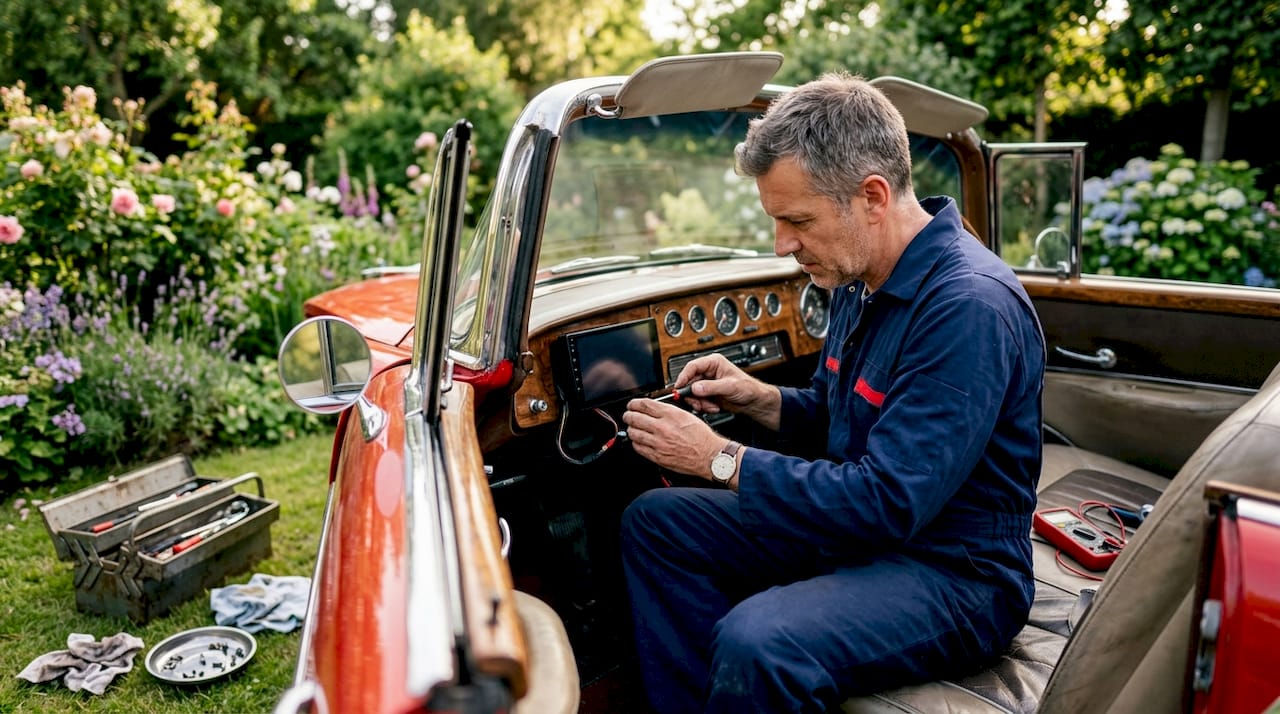
Digital clusters offer programmable needle colors, gauge layouts, and live engine vital monitoring through OBD-II sensor integration. Owners can configure warning thresholds, data logging, and display themes through a smartphone app. That level of personalization was simply not possible with mechanical gauges.
Key options in this category include:
- Entry-level digital clusters starting near $180, offering basic speed, fuel, and temperature displays with period-correct styling.
- Mid-range OBD-II integrated systems that pull live data from the engine management system, displaying oil pressure, coolant temperature, and battery voltage in real time.
- Wireless infotainment screens supporting Apple CarPlay and Android Auto, typically installed in the center console or a custom dash pod to avoid permanent modification.
Pro Tip: Always verify that a digital cluster is direct-fit verified for your specific vehicle platform before purchasing. Universal kits often require significant wiring adaptation that can introduce reliability problems.
The infotainment side of this upgrade category is equally mature. A wireless screen supporting Apple CarPlay costs roughly $180 at entry level, making connectivity one of the most accessible upgrades available. Pairing it with a discreet under-dash mounting solution keeps the original dashboard intact.
3. What are the costs and options for EV and hybrid drivetrain conversions?
Electric and hybrid conversions represent the most ambitious category of classic car tech enhancements. They are also the most debated, because they fundamentally change the mechanical character of the vehicle.
The numbers are significant. Hybrid system retrofits for classic platforms cost between $54,000 and $69,000. Full electric drivetrain conversions regularly exceed $175,000 depending on platform complexity, battery capacity, and software integration. Advanced builds incorporating Tesla drivetrains with Autopilot and Full Self-Driving software can require two-year project timelines and $40,000 or more in parts alone, before labor.
| Conversion type | Typical cost range | Project timeline | Key benefit |
|---|---|---|---|
| Hybrid retrofit | $54,000–$69,000 | 6–12 months | Retains original engine, adds electric assist |
| Full EV conversion | $75,000–$175,000+ | 1–2 years | Silent torque, reduced mechanical complexity |
| Tesla drivetrain swap | $100,000–$175,000+ | 12–24 months | Autopilot, FSD software, modern range |
The benefits are real. Electric motors deliver instant torque with no mechanical lag, which transforms the driving character of a heavy classic SUV or a vintage sports car. Ecdautodesign has built fully electric classic Defenders using Tesla drivetrains, preserving the Defender’s iconic silhouette while delivering performance the original engineers could only have imagined. The Jaguar E-Type restomod program similarly offers Tesla EV conversion alongside LT1 swap options, giving owners a genuine choice between electrification and traditional V8 power.
Pro Tip: For EV conversions, sensor data compatibility between the new drivetrain and the vehicle’s existing systems is as critical as the hardware itself. Specialized interface modules are non-negotiable for reliable operation.
The concern that electrification destroys a classic car’s soul is understandable but largely unfounded in practice. Modern powertrains deliver what the original designers would have chosen had the technology existed. The character comes from the body, the proportions, and the craftsmanship. The drivetrain is the means, not the identity.
4. Which performance and drivability upgrades does modern tech enable?
Beyond electrification, a range of technology-driven performance upgrades improves the daily usability of vintage vehicles without requiring a full drivetrain replacement.
- Bluetooth-enabled EFI systems. Bluetooth-capable fuel injection puts engine tuning directly in the owner’s hands via smartphone app. Systems like Holley’s Sniper 2 EFI platform replace carburetors with self-learning fuel injection that adjusts to altitude, temperature, and load in real time. Troubleshooting time drops significantly compared to traditional carburetor diagnosis.
- Modern transmission shift kits and coolers. Upgraded valve bodies and external coolers extend transmission life and improve shift quality in classic automatics. These are entirely internal modifications with no external visual impact.
- Coil-over suspension upgrades. Replacing original leaf springs or worn shock absorbers with coil-over units transforms handling and ride quality. Adjustable units allow owners to tune for street comfort or track performance without permanent modification.
- Fuel injection conversions. Replacing a carburetor with a throttle-body or multi-port EFI system improves cold-start reliability, fuel economy, and emissions compliance. Modern self-tuning systems require minimal calibration after installation.
The common thread across all four categories is smartphone integration. The shift toward app-based calibration represents a genuine cultural change in how owners manage classic car performance. Real-time data visibility, remote diagnostics, and over-the-air tune adjustments were unthinkable on a 1960s muscle car. They are now standard features on the best retro car tech upgrades available.
5. How to choose and implement upgrades while preserving authenticity
The most important principle in upgrading vintage vehicles is reversibility. The best modifications are unseen, bolt-on, and leave the original components intact and stored. That approach protects both the vehicle’s provenance and its market value.
A practical framework for implementation:
| Upgrade category | Impact on originality | Reversibility |
|---|---|---|
| LED lighting with electronic flasher | Low | High |
| Digital instrument cluster | Low to medium | High |
| Disc brake conversion (bolt-on) | Low | High |
| EFI system replacement | Medium | Medium |
| Full EV drivetrain conversion | High | Low |
Pro Tip: Always retain every OEM component you remove. A complete set of original parts dramatically increases a vehicle’s restoration value and gives future owners the option to return the car to factory specification.
Electrical compatibility deserves particular attention. Switching to LED lighting without updating the flasher module causes turn signal malfunctions. Installing a digital cluster without verifying OBD-II compatibility with the specific engine management system produces unreliable data. Plan the electrical architecture before purchasing components, not after.
The balance between technology and heritage is ultimately a personal decision. Some owners want a restomod that drives like a modern vehicle while looking period-correct. Others want only the safety and reliability improvements, leaving the driving character entirely original. Both approaches are valid. The key is knowing your goal before spending.
Key Takeaways
The most effective approach to modernizing old cars combines reversible safety and drivability upgrades first, then layers in digital and drivetrain technology based on budget and intended use.
| Point | Details |
|---|---|
| Safety upgrades first | Disc brakes, LED lighting, and seatbelt retrofits deliver the highest return on investment with minimal originality impact. |
| LED requires electronic flashers | Replacing mechanical thermal flashers is mandatory when installing LED lighting to prevent turn signal failure. |
| EV conversions are a major investment | Full electric drivetrain swaps cost $75,000–$175,000+ and typically require 1–2 years to complete. |
| Reversibility protects value | Retaining all removed OEM parts preserves restoration options and supports long-term vehicle value. |
| App integration is now standard | Bluetooth-enabled EFI and digital clusters depend on smartphone app calibration for reliable real-time performance. |
The soul question is the wrong question
The debate about whether technology upgrades compromise a classic car’s soul has always struck me as misframed. The soul of a vehicle lives in its proportions, its materials, its provenance, and the way it occupies space on the road. None of those qualities disappear when you replace a carburetor with a self-tuning EFI system or swap drum brakes for discs.
What I have observed, working with classic vehicle owners over many years, is that the enthusiasts most resistant to modernization are often the ones who have never driven a well-executed restomod. A Land Rover Defender with a Tesla drivetrain, coil-over suspension, and a bespoke interior does not feel like a compromise. It feels like the vehicle the original designers would have built if they had access to today’s tools.
The practical advice I give every owner is to start conservatively. Begin with safety: brakes, seatbelts, lighting. Drive the vehicle for a season. Then assess what genuinely bothers you about the driving experience. That honest assessment will tell you whether an EFI conversion, a digital cluster, or a full EV swap is the right next step. Chasing technology for its own sake produces expensive vehicles that satisfy no one. Chasing a specific driving experience, and choosing the technology that delivers it, produces something genuinely special.
The enthusiasts who get this right treat every upgrade decision as a question of intent. What do you want this vehicle to do? Answer that first. The technology follows.
— Evolve
Ecdautodesign’s approach to bespoke classic car modernization
Ecdautodesign has spent years perfecting the marriage of authenticity and capability in classic vehicle builds. Every project begins with a ground-up restoration, and every technology decision is made in service of the owner’s specific vision, not a generic upgrade checklist.
The atelier’s work on classic Defender restomod builds and the Jaguar E-Type restoration program demonstrates what is possible when technology serves heritage rather than replacing it. From Tesla EV conversions to air-ride suspension and bespoke interior finishes, each build is configured through a real-time 3D rendering tool that lets owners visualize every detail before a single component is ordered. If you are ready to define exactly what you want your classic vehicle to become, Ecdautodesign is the place to start that conversation.
FAQ
What is a restomod?
A restomod is a classic vehicle that retains its original body and styling while receiving modern mechanical and technology upgrades. The term combines “restoration” and “modification.”
How much does it cost to convert a classic car to electric?
Full EV drivetrain conversions typically cost between $75,000 and $175,000 or more, depending on platform complexity and software integration. Hybrid retrofits run $54,000–$69,000.
Do modern tech upgrades reduce a classic car’s value?
Reversible upgrades that retain all original OEM parts generally preserve or enhance value. Permanent modifications that alter original bodywork or eliminate provenance components carry the greatest risk to long-term market value.
What is the easiest first upgrade for a classic vehicle?
LED lighting with an electronic flasher replacement is one of the lowest-cost, highest-impact upgrades available. It improves visibility and reliability with no permanent modification to the vehicle.
Can a classic car run Apple CarPlay?
Yes. Wireless infotainment screens supporting Apple CarPlay and Android Auto are available at entry-level price points and can be installed without modifying the original dashboard, using under-dash or console-mounted pods.
Recommended
- HiConsumption: 12 Best Electric Classic Car Conversions – Custom Defender | Restored Defender Specialists | ECD Auto Design
- TopSpeed | Exclusive: Here’s How E.C.D. Automotive Design Modernize Classic Defenders To Perfection – Custom Defender | Restored Defender Specialists | ECD Auto Design
- Blog – Custom Defender | Restored Defender Specialists | ECD Auto Design
- Blog – Custom Defender | Restored Defender Specialists | ECD Auto Design
FREQUENTLY ASKED
QUESTIONS
No FAQs configured yet.