


Grace, Pace, and Modern Space: Upgrades to Elevate a Vintage Modified Jaguar
September 24, 2025
How to Spec a Custom Defender from Scratch
June 29, 2026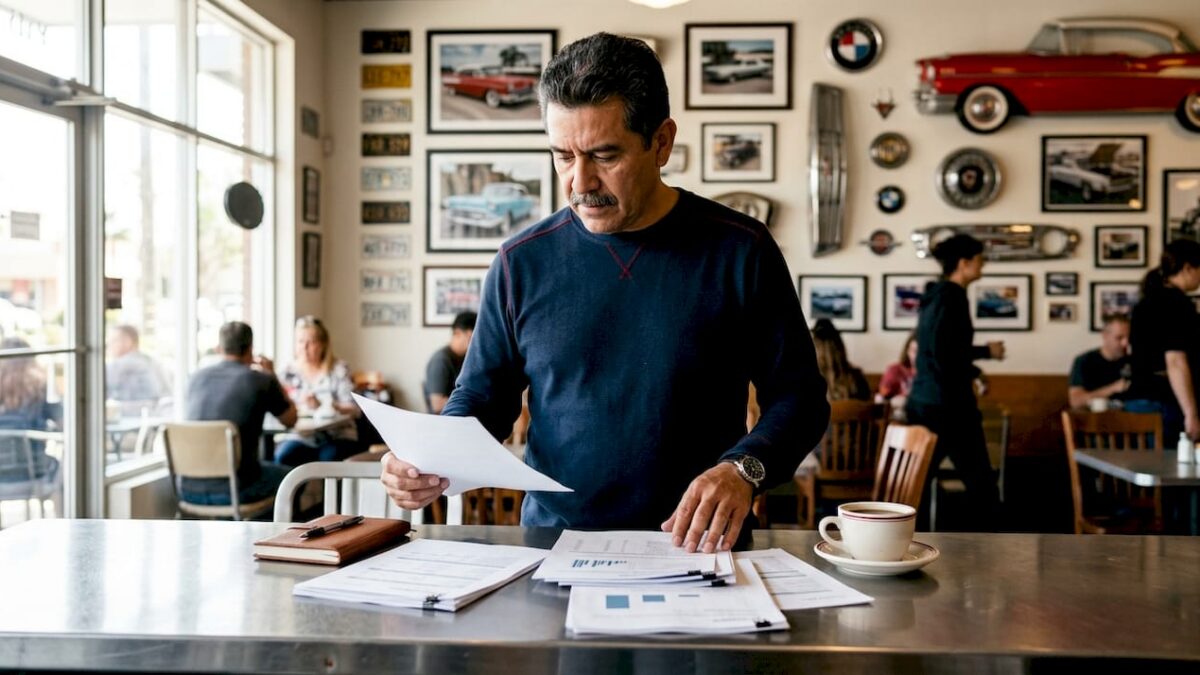
The classic vehicle export process is the legally mandated, multi-step procedure for preparing, documenting, and shipping a classic car from the United States to an international destination under full regulatory compliance. In industry terms, this procedure is often called “used vehicle export clearance,” governed primarily by U.S. Customs and Border Protection (CBP) under 19 CFR Part 192. A complete export package requires the original certificate of title, a bill of sale, export papers, and a valuation report. The U.S. 25-Year Rule also plays a role here: classic cars 25 years or older are exempt from most DOT safety and EPA emissions standards, which simplifies compliance considerably. Getting every phase right protects your vehicle, your investment, and your legal standing.
What is a classic vehicle export process, and what documents does it require?
The documentation phase is where most exports succeed or fail. Most export failures occur due to incomplete or uncoordinated paperwork, not during transit. That single fact should reframe how you approach the entire process.
Core documents required by CBP
A standard classic vehicle export package includes:
- Original certificate of title plus two complete copies, submitted to CBP at the port’s Auto Desk
- Bill of sale establishing purchase price and ownership transfer
- Original vehicle registration confirming the vehicle’s legal status
- Power of attorney if a freight forwarder files on your behalf
- Valuation report for high-value classics, required for customs clearance and insurance
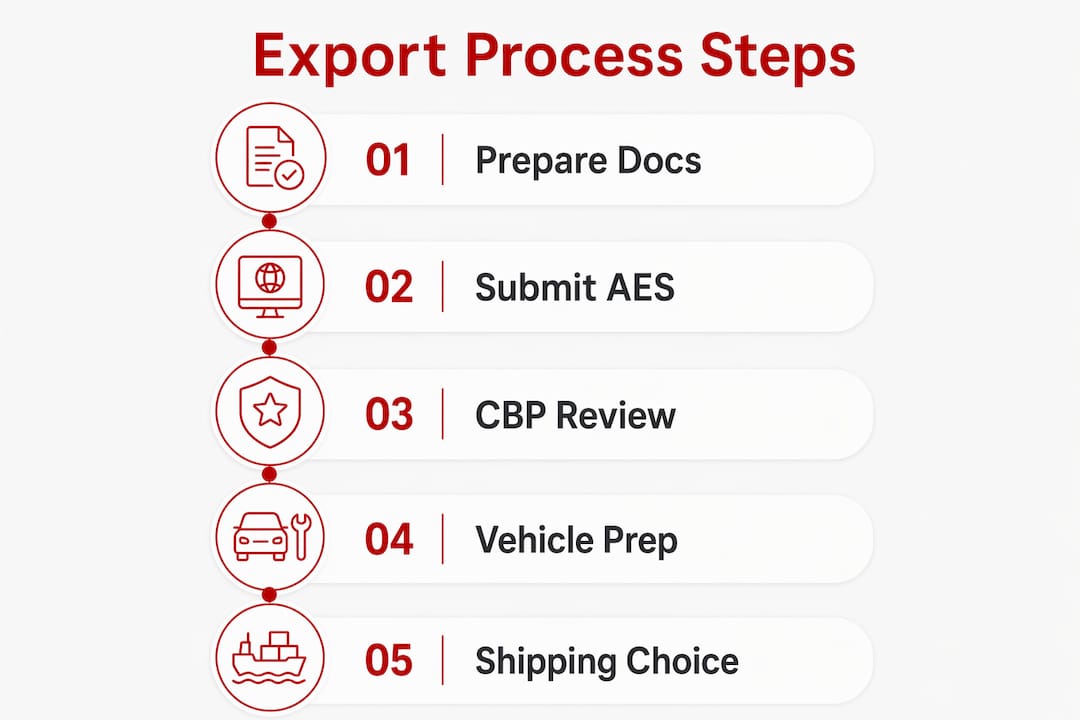
- Export declaration tied to the Electronic Export Information (EEI) filing
Vehicles with salvage titles or those operating under special import permits require additional authentication steps. Lien-free status must be confirmed before CBP will accept the title. If any financial institution holds a lien, you need a lien release letter before the title is valid for export.
The AES filing requirement every exporter must know
EEI filing through the Automated Export System (AES) is mandatory for every self-propelled vehicle exported from the U.S., regardless of value. There is no $2,500 exemption for vehicles, unlike most other export categories. This filing generates an Internal Transaction Number (ITN), which CBP requires before loading is authorized. Without a valid ITN, your vehicle does not leave the port.
Pro Tip: Never assume your freight forwarder will handle AES filing automatically. The legal responsibility for filing accuracy rests with you as the U.S. Principal Party in Interest (USPPI). Confirm in writing who is filing before any documents are submitted.
How should classic vehicles be prepared for international shipping?
Physical preparation is as critical as paperwork. A vehicle that arrives at the port dirty, fueled up, or carrying personal items can be refused by the shipping line or quarantined at the destination country.
Step-by-step preparation checklist
-
Deep clean the entire vehicle. Countries like Australia, New Zealand, and Japan enforce strict biosecurity standards. The undercarriage must be spotless. Even minor soil contamination can trigger mandatory professional cleaning at your expense or outright shipment refusal.
-
Drain the fuel tank to one quarter or less. Fuel levels above a quarter tank are a fire hazard under international maritime safety rules. Shipping lines enforce this without exception.
-
Remove all personal items. Customs inspectors treat personal belongings inside a vehicle as undeclared goods. Remove floor mats, tools, and any stored items before delivery to the port.
-
Secure or remove all loose parts. Antennas, mirrors, and custom accessories should be removed and packed separately. Loose components cause damage during loading and transit.
-
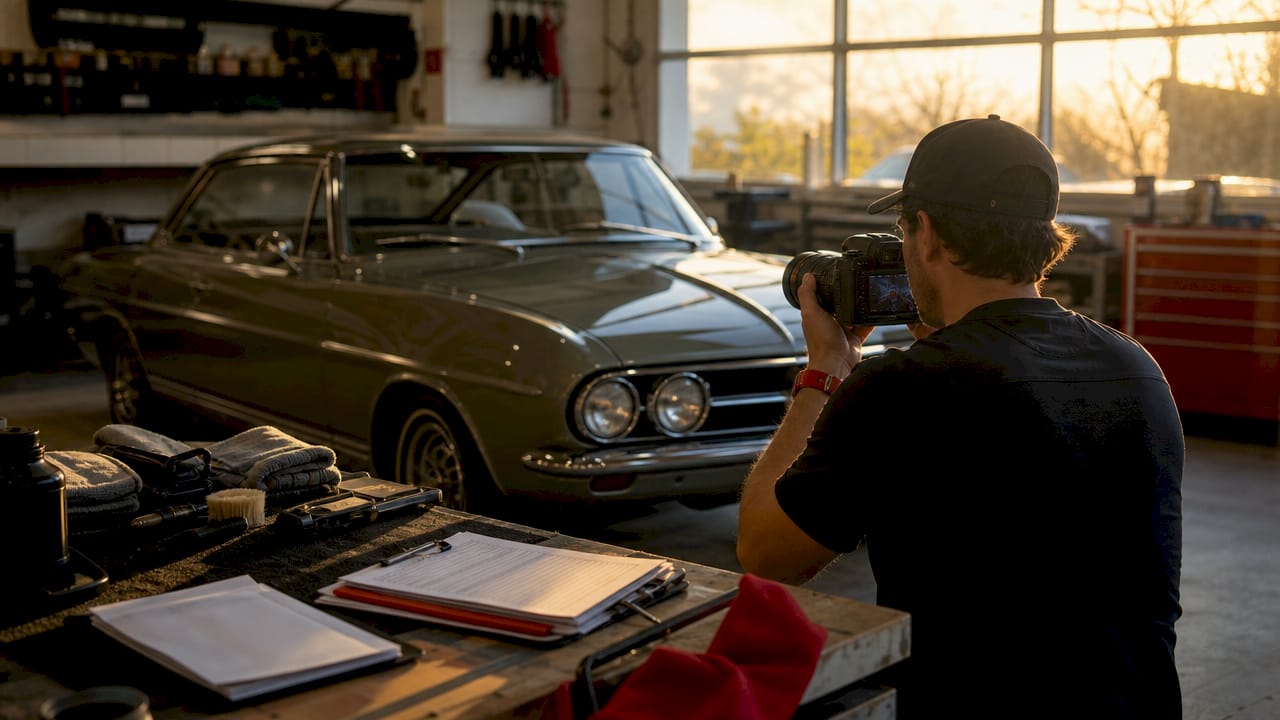
Document the vehicle’s condition with photographs. Shoot every panel, the undercarriage, the interior, and all four tires before the vehicle leaves your possession. These photos are your primary evidence for any insurance claim.
-
Disable the alarm system. An active alarm drains the battery during transit and creates complications at the destination port during unloading.
Pro Tip: If your classic car is a restomod or carries bespoke coachbuilt components, photograph every custom detail separately. Standard insurance assessors often undervalue custom work without photographic provenance.
What are the main shipping options for classic cars?
Two methods dominate the classic car shipping process: Roll-On/Roll-Off (RoRo) and container shipping. Each carries distinct trade-offs in cost, protection, and suitability.
RoRo vs. container shipping compared
| Factor | RoRo | Container shipping |
|---|---|---|
| Cost | Lower, standard rate | Higher, reflects added protection |
| Vehicle operability | Must be drivable | Can ship non-running vehicles |
| Weather exposure | Exposed on open deck | Fully enclosed |
| Theft and damage risk | Higher, shared deck | Lower, sealed container |
| Best suited for | Standard, operable classics | High-value, rare, or non-running vehicles |
| Insurance implications | Higher premiums typical | Lower premiums, broader coverage |
RoRo is the most economical option but demands a fully operable vehicle and leaves it exposed to the elements on an open deck. Container shipping costs more but delivers superior protection against theft, weather, and sea damage. For a bespoke restomod or a concours-condition classic, the container premium is not optional. It is the only responsible choice.
Key considerations when selecting your shipping method:
- Confirm the vehicle’s operability status before booking RoRo
- Request a dedicated 20-foot container for single-vehicle shipments to prevent contact damage
- Verify that your marine insurance policy covers the chosen method and destination port
- Check whether the destination country has port restrictions on RoRo vessel access
What are the critical timing steps to avoid export delays?
Timing is the most punishing variable in the classic car shipping process. A single missed deadline can strand your vehicle at the port for weeks.
The 72-hour CBP submission window
CBP requires the original title and copies at least 72 hours before the vessel’s scheduled departure. This is a hard regulatory deadline under 19 CFR Part 192, not a guideline. The vehicle must remain in the U.S. during this entire waiting period. If the port’s Auto Desk does not receive complete paperwork on time, the vehicle is denied loading and you absorb daily storage fees while waiting for the next available vessel.
Common coordination mistakes that cause delays:
- Submitting documents to the wrong port desk or the wrong CBP officer
- Providing a photocopy of the title instead of the original
- Filing AES after the 72-hour window opens instead of before
- Assuming the freight forwarder has confirmed vessel scheduling when they have not
Who is legally responsible for AES filing?
The exporter, as the USPPI, bears full legal responsibility for AES filing accuracy. Freight forwarders can file on your behalf under a power of attorney, but the penalties for errors or late filings fall on you. Incorrect commodity codes, wrong vehicle identification numbers, or missing ITNs all constitute violations under the Export Administration Regulations (EAR).
Pro Tip: Build a personal export timeline working backward from the vessel departure date. Mark the AES filing deadline, the 72-hour CBP submission window, and the vehicle delivery date to the port as three separate, non-negotiable milestones. Missing any one of them cascades into the others.
Coordination between you, your freight forwarder, and the port authority must be active, not assumed. Confirm document receipt in writing at each stage. Request the vessel’s booking confirmation number and verify it against the port’s published schedule independently.
Key Takeaways
The classic vehicle export process demands precise documentation, strict CBP timing compliance, and the right shipping method to protect both the vehicle and its provenance.
| Point | Details |
|---|---|
| Documentation is the foundation | Assemble the original title, bill of sale, registration, power of attorney, and valuation report before anything else. |
| AES filing is non-negotiable | Every vehicle export requires EEI filing through AES regardless of value; the ITN it generates is your legal clearance. |
| The 72-hour window is a hard deadline | Submit all CBP documents at least 72 hours before vessel departure or face denied loading and storage fees. |
| Container shipping protects high-value classics | For bespoke or rare vehicles, container shipping is the only method that adequately protects against damage and theft. |
| Physical preparation prevents costly delays | Clean the vehicle thoroughly, drain fuel to a quarter tank, and document condition with photos before port delivery. |
What I’ve learned from watching exporters get this wrong
The most expensive mistake I see is treating the export process as an afterthought. Collectors spend years and significant capital building or restoring a vehicle, then rush the paperwork in the final two weeks before departure. That is where provenance gets damaged, not in transit.
The second pattern is over-reliance on freight forwarders. A good forwarder is invaluable for logistics coordination, but they are not your legal proxy for AES filing unless you have signed a specific power of attorney and confirmed the arrangement in writing. I have seen exporters receive violation notices months after a vehicle arrived safely overseas because the AES filing contained errors no one caught.
Physical preparation also deserves more respect than it typically gets. A classic vehicle that has been meticulously restored and then shipped with a dirty undercarriage to a biosecurity-strict destination is a vehicle that may sit in quarantine at the owner’s cost. That outcome is entirely preventable.
My strongest recommendation is this: treat the export process as an extension of the vehicle’s care. Every document you file, every photograph you take, and every preparation step you complete adds to the vehicle’s story and protects its value at the destination. The vehicles that arrive in the best condition and clear customs fastest are the ones whose owners prepared them with the same attention they gave the restoration itself.
— Evolve
Ecdautodesign and the art of export-ready classic vehicles
Ecdautodesign builds bespoke Land Rover Defenders from the ground up, and every vehicle leaves the atelier in a condition that reflects its investment-grade provenance. That means complete documentation, a meticulous finish, and a build quality that holds up under the scrutiny of international customs inspections.
When you commission a vehicle from Ecdautodesign, you receive more than a restomod. You receive a fully documented, export-ready classic built to the standards that discerning collectors and international buyers expect. From valuation documentation to condition photography, Ecdautodesign’s process is designed to protect your vehicle’s value at every stage of its life, including its journey to a new home anywhere in the world.
FAQ
What documents are required to export a classic car from the U.S.?
You need the original certificate of title plus two copies, a bill of sale, vehicle registration, and a completed EEI filing through AES that generates an ITN. High-value classics also require a valuation report for customs and insurance purposes.
How far in advance must I submit documents to CBP for vehicle export?
CBP requires the original title and copies at the port’s Auto Desk at least 72 hours before the vessel’s scheduled departure. Missing this deadline results in denied loading and daily storage fees.
Is AES filing required for all classic car exports regardless of value?
Yes. Unlike most export categories, there is no $2,500 value exemption for self-propelled vehicles. Every vehicle export from the U.S. requires EEI filing through AES and a valid ITN for legal clearance.
What is the safest shipping method for a high-value classic car?
Container shipping is the preferred method for high-value and rare classics. It provides full enclosure, protection from weather and theft, and broader insurance coverage compared to RoRo shipping.
Does the U.S. 25-Year Rule affect the export process?
The 25-Year Rule exempts classic cars 25 years or older from most DOT safety and EPA emissions requirements, which simplifies export logistics. However, CBP documentation and AES filing requirements still apply regardless of the vehicle’s age.
Recommended
- Finding, Fixing, Finishing: How E.C.D. Automotive Design Imports Old Land Rovers for Restoration – Custom Defender | Restored Defender Specialists | ECD Auto Design
- Finding, Fixing, Finishing: How E.C.D. Automotive Design Imports Old Land Rovers for Restoration – Custom Defender | Restored Defender Specialists | ECD Auto Design
- Blog – Custom Defender | Restored Defender Specialists | ECD Auto Design
- Blog – Custom Defender | Restored Defender Specialists | ECD Auto Design
FREQUENTLY ASKED
QUESTIONS
No FAQs configured yet.