


Why Bespoke Vehicles Reflect Personal Brand Identity
July 14, 2026
What Owning a Restomod Actually Costs: Maintenance, Running Costs, and Resale
July 28, 2026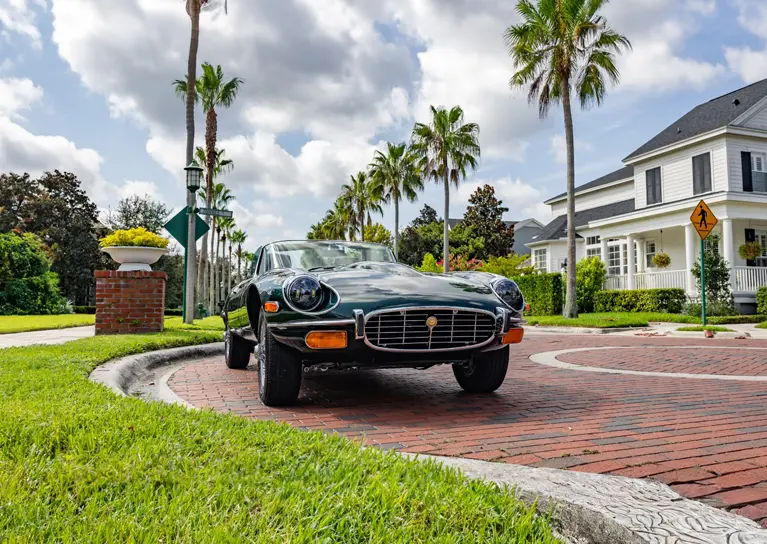
The bonnet is the first thing you notice, and it never stops being the thing you notice. From the driver’s seat it stretches out ahead of you like a runway, rising and falling with the road, the twin humps over the cam covers framing everything you are about to drive through. No modern car gives you that view. Modern cars hide their length; this one makes you steer it, aim it, thread it through corners like the nose of a boat. People who ask what a Jaguar E-Type is like to drive usually expect an answer about speed. The honest answer starts with that view over the bonnet, because it changes how you experience every mile.
Getting In Is Part of the Experience
You drop down into it rather than climb aboard. The sill is wide, the seat is low, and the big wood rimmed wheel sits closer to your chest than any modern ergonomics textbook would allow. The dash is a row of toggle switches and Smiths gauges, laid out with the logic of an aircraft panel from the same era. Nothing beeps. Nothing lights up to greet you. The car simply waits, and the ritual of settling in, adjusting the mirror, and finding the ignition is the first signal that the next hour will run at a different tempo than the rest of your day.
The Original Car Rewards You and Tests You in Equal Measure
In period trim, the straight six pulls with a long, elastic surge and a sound like tearing silk somewhere behind the firewall. The steering is alive in a way that has almost vanished from motoring, every camber change and surface texture arriving through the rim. But honesty matters here. Original cars run hot in traffic. The Moss gearbox on early examples demands patience and a deliberate hand. The brakes, advanced in 1961, ask for planning distances that feel alarming to anyone raised on ABS. Driving one well is a skill, and on the right road at the right temperature, few experiences in motoring compare. The rest of the time, the car is asking things of you that modern life makes hard to give.

What Changes When Modern Power Goes Underneath
This is where the restomod approach earns its case. Keep the body, the view, the low seat, the wood rimmed wheel, and the long nose rising ahead of you. Underneath, fit modern fuel injection that starts instantly on a cold morning, a cooling system that shrugs off a Florida summer idle, a gearbox with synchros that welcome rather than punish, and brakes that stop the car the way your instincts expect. The character does not disappear. It sharpens. The exhaust note is still there, the steering still talks, the bonnet still stretches to the horizon, but the asterisks are gone. You stop planning drives around the car’s moods and start taking it because you want to, which is the entire point of owning one.
The Drive Itself, Described Honestly
On a back road with modern power underneath, the car settles into a rhythm the original always hinted at. The nose tips into a corner and the whole car rotates around you rather than in front of you, because you sit so far back in the wheelbase. Second gear out of a tight bend brings a swell of torque the 1960s never offered, and the rear squats and drives instead of scrambling. At a cruise, the cabin is calm enough for conversation. At a stoplight, the temperature gauge sits still. And when a stranger at a gas station asks what year it is, the answer is still 1965 or 1967 or 1969, because everything they are looking at is exactly what Malcolm Sayer drew.
Why This Car, Chosen Deliberately, Instead of Something Newer
Enzo Ferrari is widely credited with calling it the most beautiful car ever made, and Hagerty’s driving coverage of the E-Type suggests enthusiasts have never stopped agreeing. But beauty alone does not explain why people choose this car over a modern convertible with three times the equipment. They choose it because the experience cannot be manufactured new at any price: the view, the sound, the sense of occasion in a grocery run. A restored Jaguar E-Type built to the owner’s specification, in convertible or fastback form, is how ECD Auto Design resolves the tension between wanting that experience and wanting to actually use it. The buyer decides how far the modernization goes, from subtle reliability work to a full drivetrain transformation, and the car that results is one they drive rather than store.
What is it like to drive? It is the rare car that makes you a better, more attentive driver simply by sitting in it, and with modern engineering underneath, it lets you feel that way as often as you like.
FREQUENTLY ASKED
QUESTIONS
No FAQs configured yet.