


What Is a Safari-Ready Vehicle? Your 2026 Guide
July 5, 2026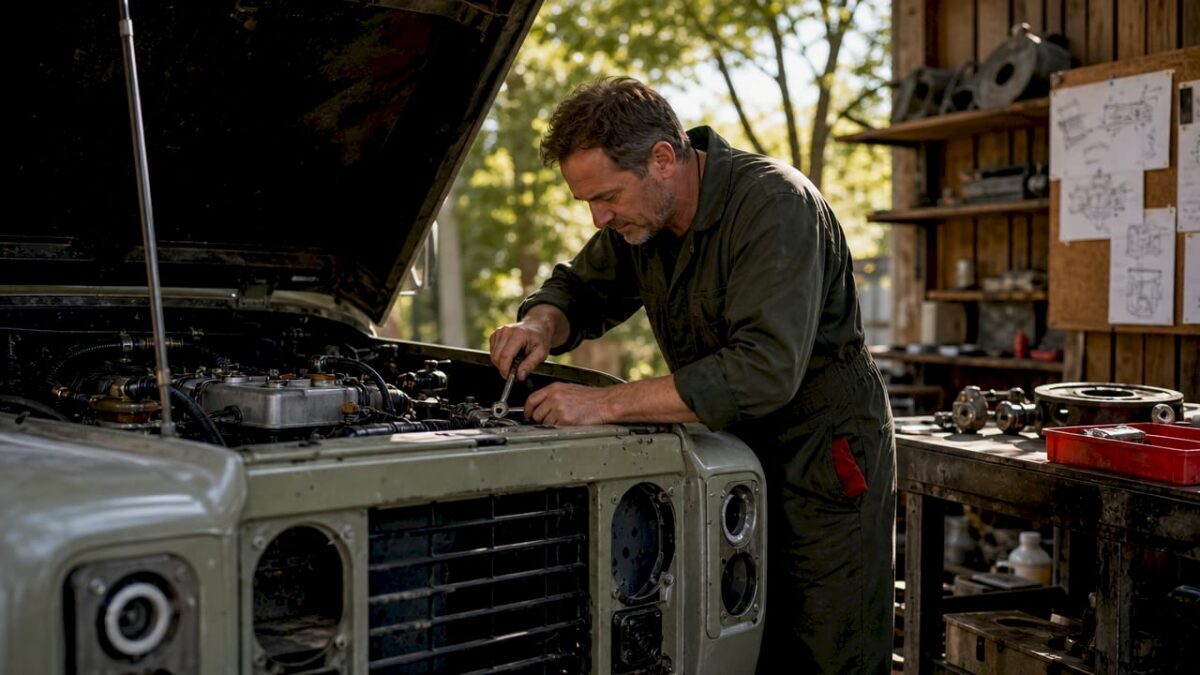
A restored Land Rover Defender is defined by the marriage of original engineering durability and expert restoration workmanship that together produce a vehicle you can depend on daily. Understanding why restored Defenders are reliable requires looking at two things simultaneously: the mechanical DNA Land Rover built into every Defender from the factory, and the quality of the restoration process applied decades later. The Defender’s simple, ladder-frame chassis, proven engine options like the 300Tdi and Td5, and its reputation for repairability give restorers a strong foundation. When a specialist applies chassis galvanizing, precision engine rebuilds, and sympathetic upgrades, the result is a trustworthy classic car that performs with modern predictability.
Why restored Defenders are reliable: the original engineering advantage
The Land Rover Defender earns its reputation for durability before a restorer ever touches it. Its mechanical design prioritizes simplicity over complexity, which means fewer failure points and easier repairs. That philosophy translates directly into restoration advantages no modern SUV can replicate.
Several engineering traits make the original Defender a strong candidate for reliable restoration:
- Ladder-frame chassis: The Defender’s separate body-on-frame construction allows restorers to address corrosion and structural damage without compromising the entire vehicle. Each section can be repaired or replaced independently.
- Proven engine options: The 2.25 petrol, 300Tdi, and Td5 engines are renowned for durability when properly overhauled and maintained. Their mechanical simplicity means a skilled technician can rebuild them to factory tolerances using widely available parts.
- Parts availability: The Defender’s long production run, from 1983 to 2016, created a vast global aftermarket. Replacement parts remain accessible and affordable compared to most classic vehicles of similar age.
- Repairability by design: Early Defenders were engineered for field repairs in remote terrain. That design philosophy means most mechanical systems are accessible, logical, and serviceable without specialist equipment.
These traits do not guarantee reliability on their own. They guarantee that a quality restoration has excellent raw material to work with. The Defender’s bones are sound. What a restorer does with those bones determines everything.
How does quality restoration improve Defender reliability?
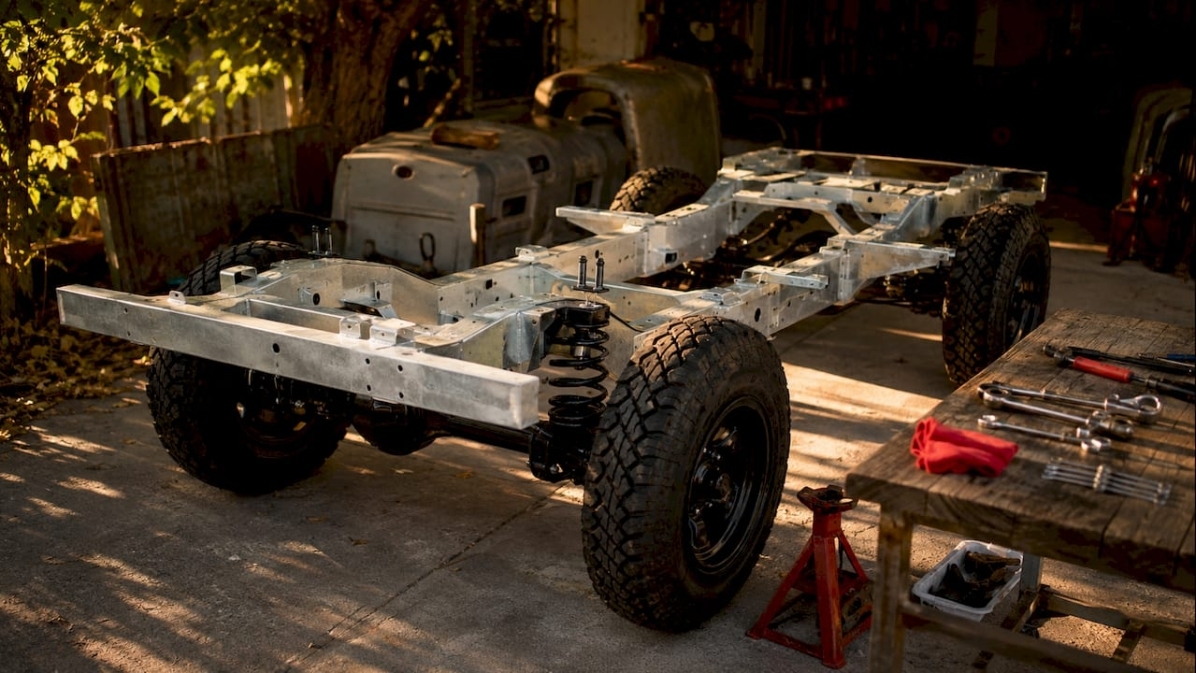
Restoration quality is the single greatest predictor of long-term dependability in a classic Defender. A properly restored Defender can be dependable and predictable, reflecting the durability and repairability inherent in the original design. That dependability does not happen by accident.
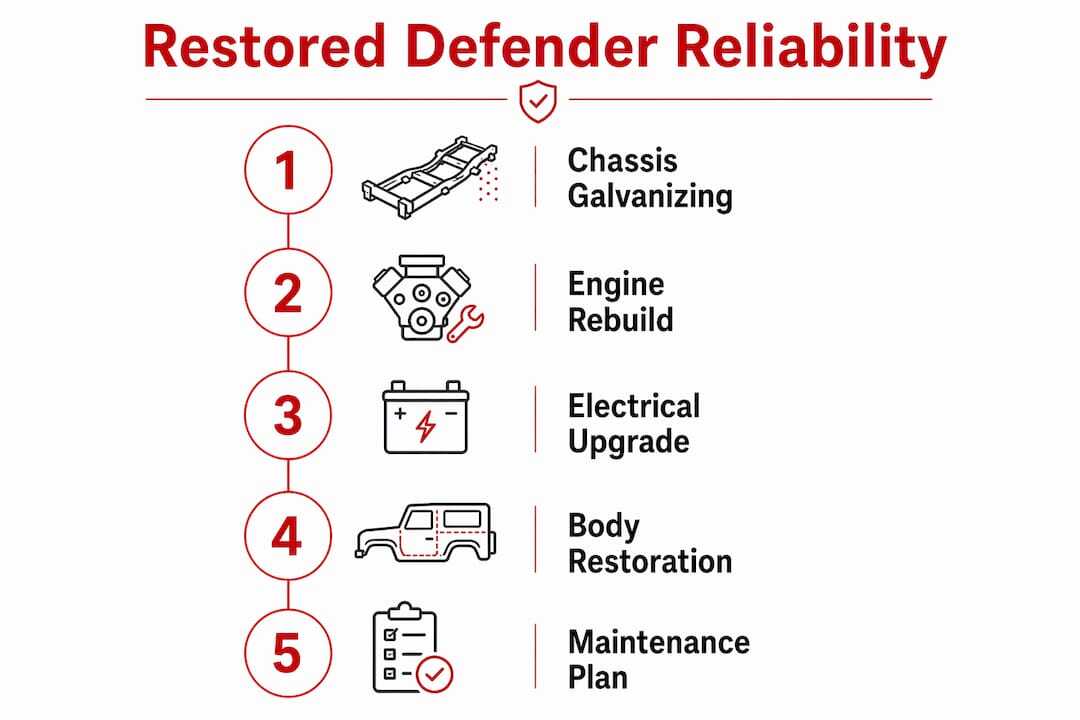
The most impactful restoration processes include:
- Full chassis galvanizing: Chassis galvanizing prevents corrosion and extends vehicle life significantly. Rust is the primary killer of classic Defenders, and galvanizing the chassis during restoration eliminates that threat at the structural level.
- Precision engine rebuilds: Rebuilding a 300Tdi or Td5 with quality parts and proper machining restores compression, oil pressure, and thermal efficiency to factory specifications. A freshly rebuilt engine often outperforms a tired original with low mileage.
- Electrical system overhaul: Classic Defenders carry a reputation for electrical gremlins. A thorough restoration replaces aging wiring looms, corroded connectors, and failing switches with modern equivalents that perform reliably.
- Restomod upgrades: V8 conversions and modern diesel swaps deliver enhanced performance and reliability beyond original specifications. These upgrades address common issues like carburetor problems and cooling inefficiencies, increasing overall trustworthiness without compromising the vehicle’s classic character.
Pro Tip: Request a full restoration log before purchasing any classic Defender. A documented build record covering chassis work, engine rebuild specifications, and electrical upgrades tells you more about future reliability than mileage or production year ever could.
Sympathetic restorations deserve special mention. These builds preserve original appearance while discreetly upgrading reliability and comfort, making them ideal for daily drivers that still read as authentic classics. The result is a vehicle that satisfies both the collector’s eye and the commuter’s expectations.
What maintenance keeps a restored Defender reliable long-term?
Restoration quality sets the ceiling for reliability. Disciplined maintenance determines whether a restored Defender reaches that ceiling or falls short of it. Owners who apply a consistent maintenance schedule preserve the restored condition and keep the vehicle operating predictably for years.
The core maintenance routine for a restored Defender follows this sequence:
- Grease all chassis and suspension points every 3,000 miles or at the start of each season. The Defender’s numerous grease nipples protect ball joints, prop shafts, and steering components from accelerated wear.
- Inspect for corrosion at every service interval, paying particular attention to outriggers, bulkhead seams, and floor sections. Even a galvanized chassis benefits from annual visual checks.
- Change engine oil and filter every 3,000–5,000 miles depending on driving conditions. Td5 and 300Tdi engines reward frequent oil changes with extended service life.
- Check brake fluid and hydraulic systems every six months. Classic Defender brake systems use straightforward hydraulics that respond well to regular fluid replacement and caliper inspection.
- Use a smart battery charger during storage periods. Long-term reliability depends heavily on owner aftercare including smart battery maintenance, which prevents sulfation and preserves electrical system integrity.
Pro Tip: Store your restored Defender in a dry, ventilated space rather than a sealed garage. Moisture trapped under a cover accelerates corrosion on body seams and door frames, even on a well-restored vehicle.
Driving habits also matter. Regular use keeps seals lubricated, prevents brake discs from corroding, and allows the owner to catch developing issues early. A restored Defender driven weekly is almost always more reliable than one stored for months between outings. For detailed guidance on long-term care practices, the specifics of each service interval make a measurable difference.
What are the benefits of choosing a restored Defender over other classic SUVs?
Restored Defenders occupy a unique position in the classic SUV market. They combine iconic styling with proven off-road capability, strong parts support, and collector-grade provenance in a package that few other vehicles can match.
| Benefit | Restored Defender advantage |
|---|---|
| Styling and heritage | Unmistakable silhouette with 70-plus years of design provenance |
| Parts availability | Global aftermarket with widely stocked components for all major systems |
| Off-road capability | Permanent four-wheel drive and high ground clearance standard across all variants |
| Resale value | Documented restorations command premium prices and attract serious collectors |
| Daily usability | Sympathetic restomods deliver modern comfort without sacrificing classic character |
The resale value point deserves emphasis. Collectors prize documented, period-correct restorations for both investment and trustworthiness. A Defender with a clear restoration history, complete service records, and traceable provenance sells at a meaningful premium over an undocumented example. That premium reflects the market’s recognition that restoration quality is the true measure of value.
The Defender also benefits from one of the strongest enthusiast communities of any classic vehicle. Owner forums, specialist workshops, and dedicated parts suppliers create an ecosystem that supports long-term ownership in ways that more obscure classic SUVs simply cannot match.
Common misconceptions about restored Defender reliability
The most persistent myth about classic Land Rovers is that they are inherently unreliable. That reputation belongs to neglected examples, not properly restored ones. The distinction matters enormously.
- “All old Defenders break down constantly.” This applies to unrestored, poorly maintained vehicles. A thoroughly restored Defender with a rebuilt drivetrain and galvanized chassis behaves with modern predictability.
- “High mileage means low reliability.” Mileage and production year correlate far less with reliability than the quality and thoroughness of restoration and maintenance. A comprehensively restored 1985 Defender can outperform a neglected 2005 example with half the miles.
- “Restored Defenders need no maintenance.” Restored vehicles are highly predictable with care, not zero-maintenance. The difference is that a well-restored Defender tells you what it needs and when, rather than surprising you with catastrophic failures.
- “Only static collector cars are reliable.” Regularly driven restored Defenders are typically more reliable than stored ones. Consistent use keeps mechanical systems exercised and allows owners to identify wear before it becomes failure.
Proper restoration shifts a classic Defender’s reliability profile from unpredictable to manageable. That shift is the core value proposition of expert restoration work.
Key Takeaways
A restored Land Rover Defender is reliable because expert restoration addresses every structural and mechanical weakness while preserving the original design’s proven durability, simplicity, and repairability.
| Point | Details |
|---|---|
| Original engineering is the foundation | The Defender’s simple chassis, proven engines, and repairability give restorers excellent raw material. |
| Chassis galvanizing is non-negotiable | Full galvanizing during restoration eliminates corrosion, the primary cause of classic Defender failure. |
| Restoration quality outweighs mileage | A thoroughly restored older Defender is more reliable than a neglected newer example. |
| Disciplined maintenance sustains reliability | Regular greasing, fluid changes, and corrosion checks preserve the restored condition long-term. |
| Documented provenance adds value | Clear restoration records increase resale value and buyer confidence significantly. |
What I’ve learned from years around restored Defenders
The conventional wisdom says classic Land Rovers are unreliable. I think that framing misidentifies the problem entirely. The vehicles are not unreliable. Neglect is unreliable. A Defender that has been stripped to bare metal, galvanized, rebuilt with quality components, and maintained on a disciplined schedule behaves with a consistency that surprises people who expect drama.
What I find genuinely compelling about restored Defenders is how honest they are as machines. The drivetrain options are logical, the systems are accessible, and the failure modes are predictable. When something needs attention, the vehicle tells you clearly and early. That transparency is a form of reliability that modern vehicles with complex electronics often cannot offer.
The owners who struggle with their restored Defenders almost always share one trait: inconsistent maintenance. The vehicles reward discipline with dependability. They punish neglect with compounding problems. That relationship is not a flaw. It is a feature of any mechanical system built before the era of self-monitoring software.
My honest recommendation is to treat service records as seriously as the restoration itself. A Defender with a meticulous build log and three years of documented maintenance is worth considerably more than one with a beautiful exterior and no paper trail. Craftsmanship as currency only holds its value when the record proves it.
— Evolve
Ecdautodesign’s approach to building Defenders that last
Ecdautodesign has built its reputation on ground-up Defender restorations that treat reliability as a design requirement, not an afterthought. Every build begins with structural assessment, chassis galvanizing, and a full mechanical rebuild before any attention turns to aesthetics.

The team at Ecdautodesign applies restomod philosophy with precision, incorporating modern drivetrain options, upgraded electrical systems, and bespoke interior finishes that complement rather than compromise the Defender’s original character. The result is a vehicle that reads as a classic and performs as a modern bespoke build. Each completed Defender leaves with full documentation, giving its owner both the confidence of a proven restoration and the provenance that collectors and insurers require.
FAQ
What makes a restored Defender more reliable than an original?
A restored Defender addresses the structural and mechanical wear that accumulates over decades, replacing corroded chassis sections, rebuilding engines to factory tolerances, and overhauling electrical systems. The result is a vehicle that combines original engineering strengths with components in like-new condition.
Does mileage affect the reliability of a restored Defender?
Mileage correlates far less with reliability than restoration quality. A thoroughly restored high-mileage Defender can be more dependable than a low-mileage example that has been neglected or poorly maintained.
What is the most important restoration step for long-term reliability?
Full chassis galvanizing is the single most critical restoration step. It eliminates corrosion at the structural level and extends the vehicle’s service life significantly beyond what paint or underseal alone can achieve.
Are restored Defenders suitable for daily driving?
Sympathetic restorations that include upgraded electrical systems, rebuilt drivetrains, and modern comfort features make restored Defenders fully capable daily drivers. Regular use also benefits the vehicle by keeping mechanical systems exercised and seals lubricated.
How do I verify the reliability of a restored Defender before buying?
Request the complete restoration log, including chassis work specifications, engine rebuild records, and electrical system documentation. A documented restoration with clear provenance is the strongest indicator of future reliability and also supports resale value.
Recommended
- Instead of the new SUV, try the Classic Defender – Custom Defender | Restored Defender Specialists | ECD Auto Design
- Custom Defender | Restored Defender Specialists | ECD Auto Design
- Blog – Custom Defender | Restored Defender Specialists | ECD Auto Design
- Blog – Custom Defender | Restored Defender Specialists | ECD Auto Design
FREQUENTLY ASKED
QUESTIONS
No FAQs configured yet.