


Vehicle Build Sheet Explained: What Buyers Must Know
July 20, 2026
Vehicle Restoration Warranty Explained: What You Need to Know
July 23, 2026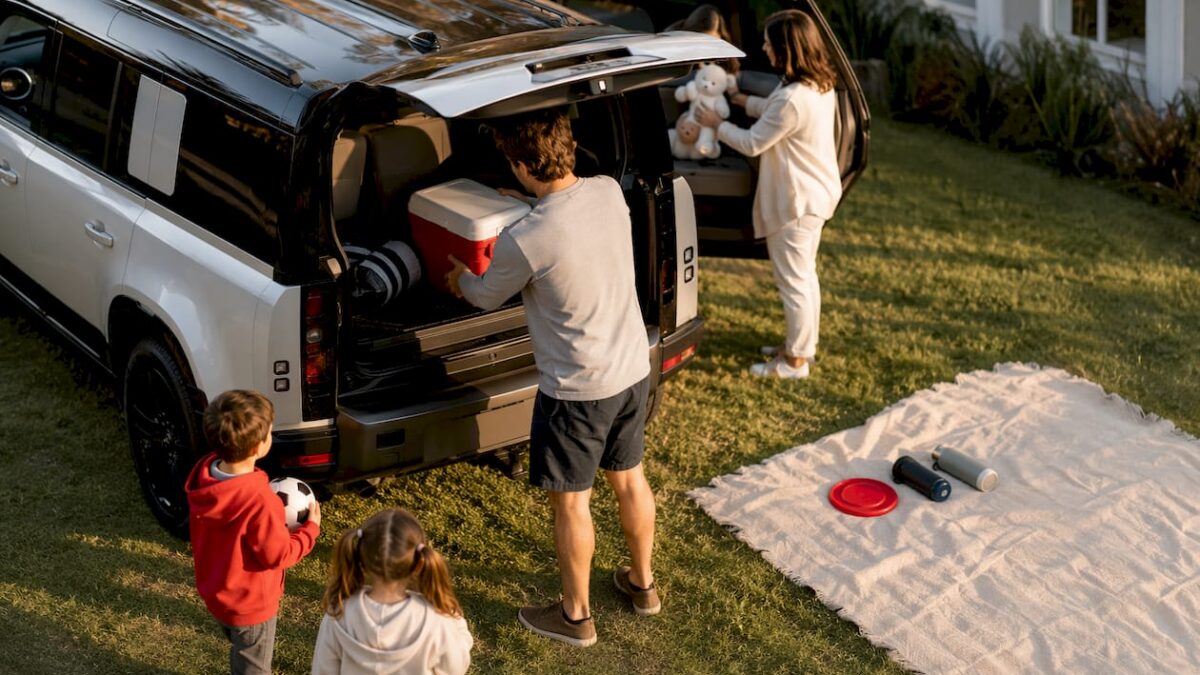
The Land Rover Defender 110 is the most practical choice for families who want to configure a capable, comfortable daily driver without compromising on urban usability. Three body styles exist across the 2026 lineup, each serving a distinct family profile: the compact Defender 90 suits couples or small households who prioritize agility; the five-door Defender 110 strikes the ideal balance of seating, cargo, and maneuverability for families of three to five; and the Defender 130 accommodates up to eight passengers with adult-friendly third-row legroom. Configuring your Defender family daily driver well means choosing the right model first, then layering in the features that make everyday life genuinely easier.
Key configuration decisions to make before you buy:
- Model: Defender 110 for most families; Defender 130 for households of six or more
- Powertrain: P300 four-cylinder turbo petrol or diesel for daily fuel economy; V8 for weekend character, not commuting
- Suspension: Air suspension for ride quality and garage clearance
- Seating: Third-row option on the 110 for occasional extra passengers
- Tech: Pivi Pro infotainment, 360-degree cameras, and adaptive cruise for urban and highway use
- Comfort: Three-zone climate control, heated seats, and washable load liners
How the Defender’s interior serves family comfort and daily usability
The Defender 110’s cabin is a deliberate marriage of rugged durability and modern refinement. Standard seating covers five passengers, with ample second-row legroom that gives rear occupants genuine breathing room, not the token space found in many similarly priced SUVs. Opt for the 5+2 configuration and two additional fold-out seats emerge from the boot floor, though these suit children far better than adults on longer trips.
The Pivi Pro infotainment system, presented on a 13.1-inch touchscreen, anchors the family tech experience. Its interface is intuitive enough that passengers can manage navigation, media, and climate without pulling the driver’s attention. Three-zone climate control, available as an option, lets rear passengers set their own temperature independently, which any parent of opinionated children will recognize as a genuine quality-of-life upgrade.
Interior storage is thoughtfully distributed: deep door pockets, under-seat cubbies, and a configurable load floor accommodate the daily accumulation of school bags, sports gear, and grocery runs. A refrigerated compartment beneath the center armrest keeps drinks cold on longer trips. Owners consistently praise heated seats and premium finishes as the details that make the Defender feel genuinely luxurious rather than merely capable.
Key interior options worth specifying:
- Three-zone climate control for independent rear temperature management
- Heated front and rear seats for year-round comfort
- Refrigerated center cubby for family road trips
- Washable load liner to protect cargo space from muddy boots and wet gear
- 5+2 seating pack for occasional third-row use on the 110
- Premium audio upgrade (Meridian 400W or 700W) to counter road noise at highway speeds
Is the Defender genuinely manageable in city and suburban driving?
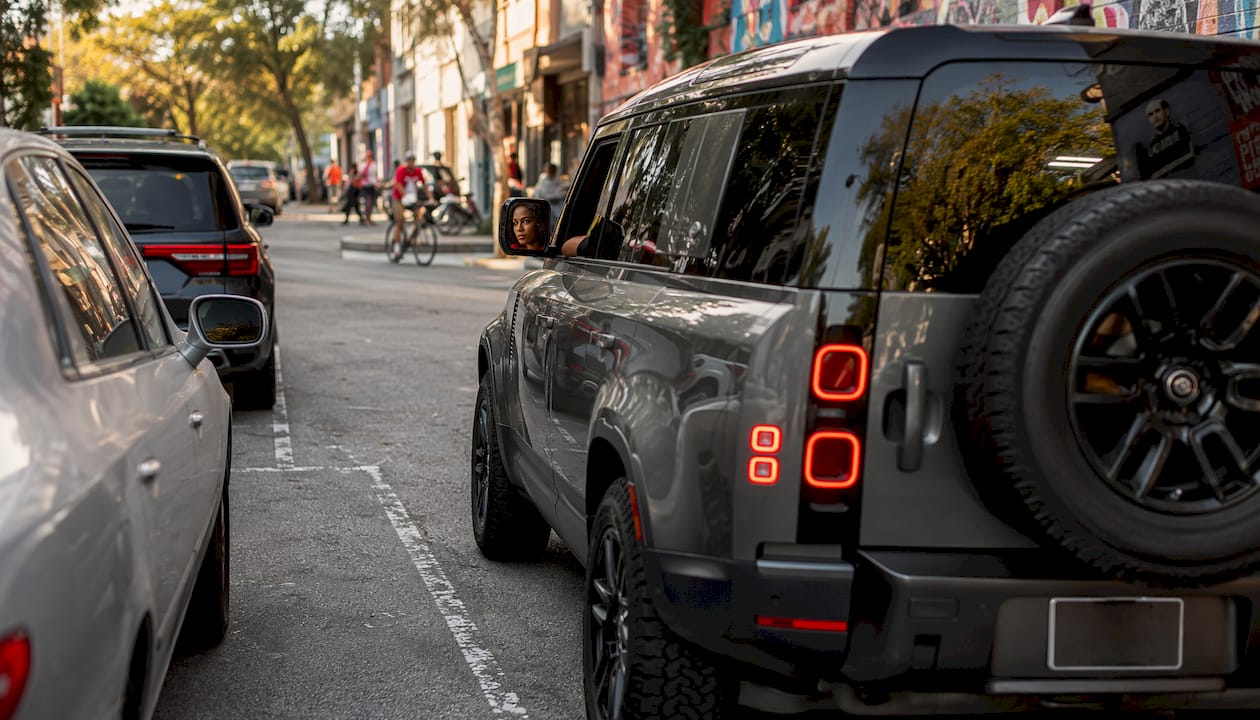
The Defender’s physical presence is real, and pretending otherwise serves no one. At its dimensions, parallel parking on a busy urban street demands attention. What mitigates this considerably is the combination of 360-degree camera systems and advanced parking sensors, which give drivers a precise overhead view of the vehicle’s footprint in tight spaces. Experienced owners actually prefer the 360-degree camera over relying on sensors alone, since factory parking sensors can trigger frequent alerts in dense urban settings, creating noise without useful information.
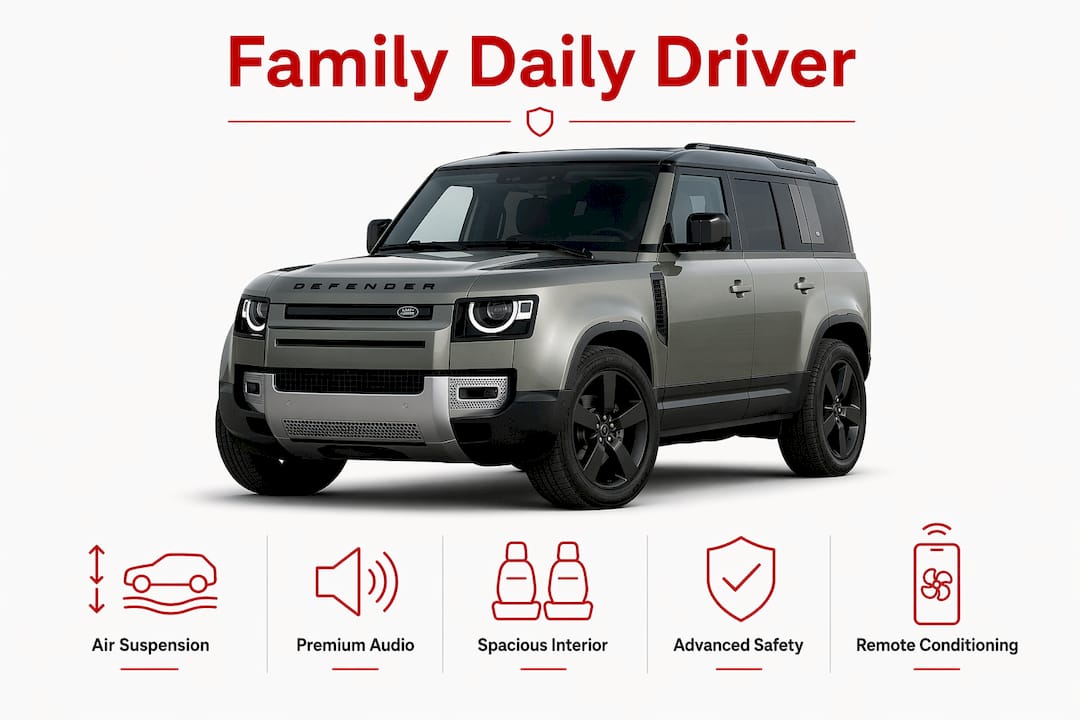
Air suspension transforms the Defender’s urban character. Owners value it as indispensable for city driving because it allows ride height adjustment at the touch of a button, clearing low garage ceilings that would otherwise be a daily frustration. On rough urban pavement, the suspension absorbs undulations with a composure that belies the Defender’s off-road pedigree.
For powertrain selection, the P300 four-cylinder turbo petrol delivers brisk city and highway performance with economy suited to daily commuting. Diesel options offer even lower running costs for high-mileage suburban drivers. The V8, while magnificent, is powertrain overkill for school runs and grocery trips. Service intervals run approximately every two years or 34,000km, a notably long cycle that reduces the maintenance burden for daily drivers.
Pro Tip: Specify air suspension and learn the key fob height-adjustment trick: with hazard lights on, lock and unlock the vehicle, then hold the headlight and unlock button to raise the ride height. This is particularly useful before entering low-clearance parking structures.
Key driver aids for urban and suburban use:
- 360-degree surround camera for precise parking
- Adaptive cruise control for highway commuting
- Parking sensors (adjust sensitivity settings to reduce false alerts)
- Air suspension for ride height control and comfort
- Terrain Response 2 for confident handling across varied road surfaces
Pros and cons of driving a Defender daily with your family
The Defender earns its place as a family daily driver through genuine versatility. Four doors on the 110 make entry and exit effortless for children and adults alike, and the commanding driving position delivers clear sightlines in traffic. The Defender 110 offers up to 78.8 cubic feet of cargo space with all rear seats folded, accommodating everything from flat-pack furniture to a full week of family luggage. ISOFIX points are generously distributed, and the wide-opening rear doors with a low load floor make loading child seats and strollers straightforward.
The trade-offs are real and worth naming plainly. Road noise at highway speeds is the most commonly cited daily-driver frustration, particularly with the standard audio system, which owners describe as inadequate for a vehicle at this price point. The Defender’s size, while manageable with the right tech aids, does demand more spatial awareness than a compact crossover. Fuel economy in city traffic reflects the vehicle’s capability-first engineering.
Pros:
- Iconic styling with genuine off-road capability held in reserve
- Generous cargo space and flexible seating configurations
- Strong ISOFIX provision and child seat compatibility
- Commanding visibility and confident highway presence
- Long service intervals reduce routine maintenance frequency
Cons:
- Standard audio system struggles against road noise at speed
- Physical dimensions require deliberate parking technique in tight urban spaces
- Fuel consumption in stop-and-go traffic is higher than compact SUVs
- Third-row seats on the 110 suit children, not adults, on longer journeys
- Mild-hybrid cold starts can surprise new owners after short stops
Recommended upgrades and configurations for family daily driving
Owner experience and expert guidance converge on a clear set of upgrades that transform the Defender from capable to genuinely refined for family daily use. Side steps are among the first additions most families specify: they make entry and exit dramatically easier for young children and reduce the effort of loading rear-facing child seats. A washable load liner protects the cargo floor from the inevitable accumulation of muddy boots, sports bags, and wet gear that defines family life.
The audio upgrade deserves particular emphasis. Owners who skipped the Meridian system at order time consistently report regretting it. The standard system cannot compete with road noise at highway speeds, and the Meridian 400W or 700W surround option costs far less at the factory than an aftermarket solution later. For families who spend meaningful time on the highway, this is the single upgrade with the highest daily-life return.
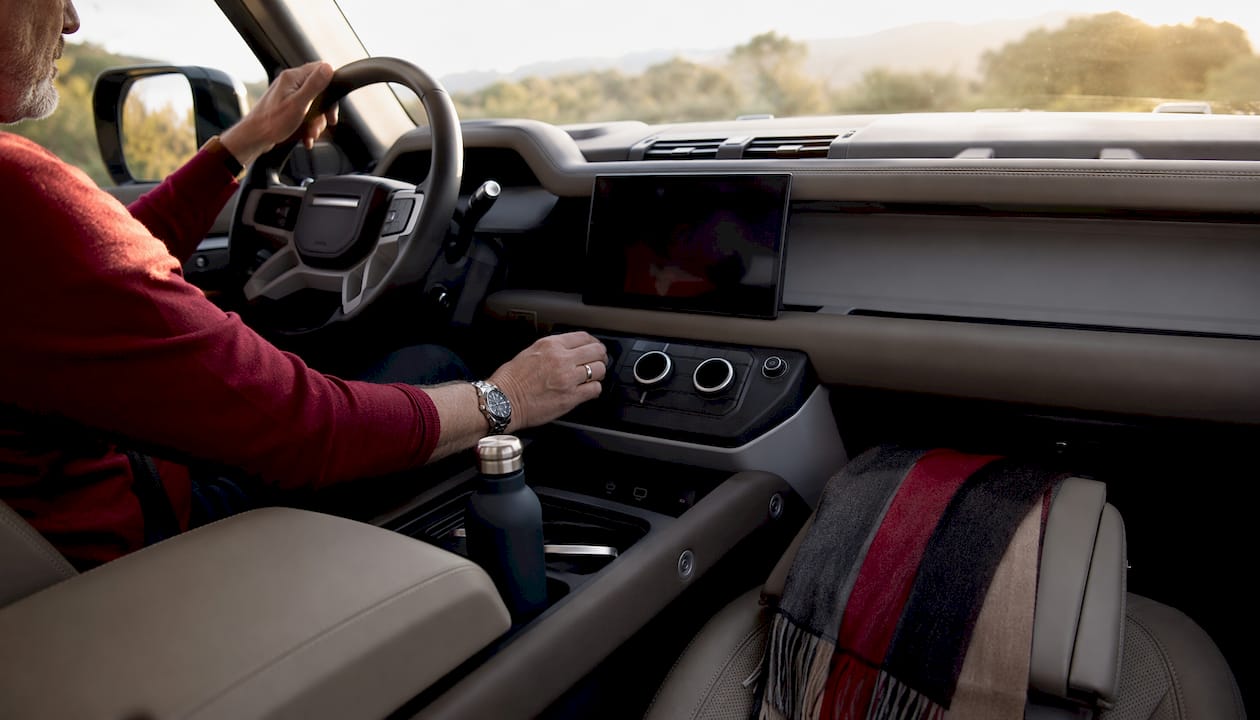
Remote pre-conditioning, which allows you to warm or cool the cabin before departure via the key fob or app, is especially valued by families in climates with extreme summers or winters. The 360-degree camera system earns its specification cost many times over in urban parking scenarios, and owners with experience in dense city environments consistently prioritize it over relying on sensors alone.
Pro Tip: When configuring a new Defender, specify the Meridian audio upgrade, air suspension, and 360-degree camera system before delivery. These three options address the most commonly cited daily-driver frustrations and cost significantly less at the factory than as aftermarket additions.
Owner-approved upgrades for family daily driving:
- Side steps for easier child and passenger entry
- Washable load liner for cargo protection
- Meridian audio system (400W or 700W) to counter road noise
- Air suspension for ride comfort and garage clearance
- 360-degree camera for urban parking confidence
- Remote pre-conditioning for cabin temperature control before departure
- Three-zone climate control for independent rear passenger comfort
For families who want to go further, Ecdautodesign’s bespoke build process opens the full spectrum of customization, from custom drivetrain options tailored to daily driving demands to interior finishes that reflect genuine personal taste rather than factory defaults. Every Ecdautodesign build begins with a ground-up restoration, meaning the family daily driver you configure is built to your specification from the first bolt, not assembled from a trim-level menu.
If you’re ready to configure a Defender that serves your family’s daily life without compromise, Ecdautodesign’s bespoke Defender 110 builds represent the fullest expression of what this platform can become. The 3D rendering configurator lets you visualize every detail in real time, from drivetrain to interior finish, before a single component is sourced.
Key Takeaways
The Defender 110, configured with air suspension, a premium audio system, and 360-degree cameras, is the most practical family daily driver in the 2026 Defender lineup.
| Point | Details |
|---|---|
| Best model for most families | The Defender 110 balances seating, cargo, and urban maneuverability better than the 90 or 130 for daily use. |
| Powertrain for daily driving | The P300 petrol or diesel delivers the fuel economy and smooth performance suited to commuting; the V8 is better reserved for weekend use. |
| Service interval advantage | Maintenance intervals run approximately every two years or 34,000km, reducing the routine upkeep burden for daily drivers. |
| Three upgrades with the highest return | Air suspension, the Meridian audio system, and 360-degree cameras address the most common daily-driver frustrations at factory cost. |
| Cargo capacity on the 110 | With all rear seats folded, the Defender 110 offers up to 78.8 cubic feet of cargo space, accommodating full family loads. |
Recommended
- Why Restored Defenders Suit Daily Driving in 2026
- Custom Defender LT4 Drivetrain Solution and Comparison – Custom Defender | Restored Defender Specialists | ECD Auto Design
- From Defender V8 to Electric | Custom Defender Engine Options – Custom Defender | Restored Defender Specialists | ECD Auto Design
- Benefits of Adding a Diesel Defender to Your Garage – Custom Defender | Restored Defender Specialists | ECD Auto Design
FREQUENTLY ASKED
QUESTIONS
No FAQs configured yet.