


What Is a Concours-Ready Restoration? The Full Guide
July 17, 2026
Configure Your Defender as a Family Daily Driver
July 22, 2026
A vehicle build sheet is defined as the internal factory document that records the exact specifications, options, and assembly details of a specific vehicle tied to its unique VIN. Unlike a window sticker, this document was never meant for the showroom floor. It lived on the assembly line, traveled with the car through production, and captured every decision made at the factory level. For collectors, restorers, and discerning buyers, the build sheet is the closest thing to a vehicle’s birth certificate. Understanding it is the first step toward verifying what you actually own or plan to purchase.
What is a vehicle build sheet?
A vehicle build sheet is the authoritative assembly-line document detailing the exact configuration, paint, trim, and factory options for a vehicle linked to its unique 17-character VIN. Every code on that sheet corresponds to a decision made before the car left the factory floor. Engine type, transmission, axle ratio, interior trim, and paint color are all captured using manufacturer-specific shorthand.
The industry also refers to this document as a “vehicle build certificate” or “factory build record,” depending on the manufacturer. Both terms describe the same thing: a technical snapshot of how a specific unit was assembled. The distinction matters because some manufacturers issue formal heritage certificates based on archived build data, while others provide raw code sheets.
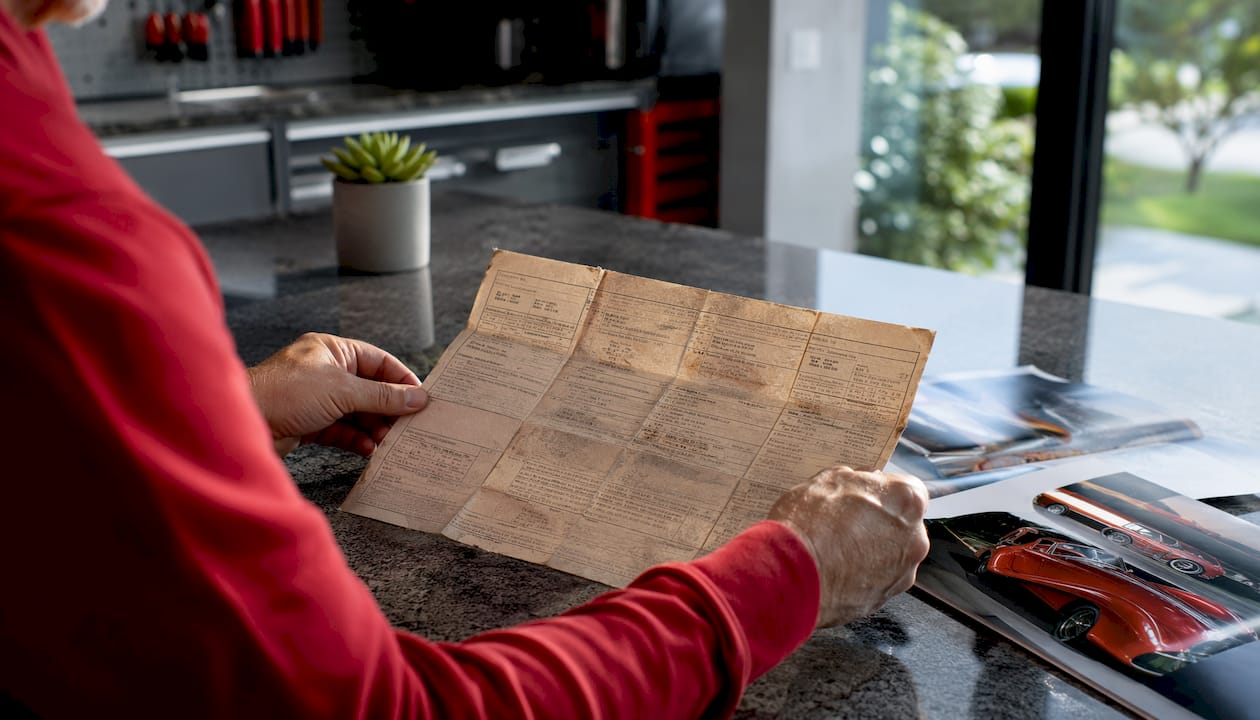
What separates a build sheet from any other vehicle document is its granularity. A Carfax report tells you where a car has been. A build sheet tells you what the car actually is at the component level. That difference is everything when you are evaluating a collector vehicle or planning a restoration.
What information does a build sheet contain?
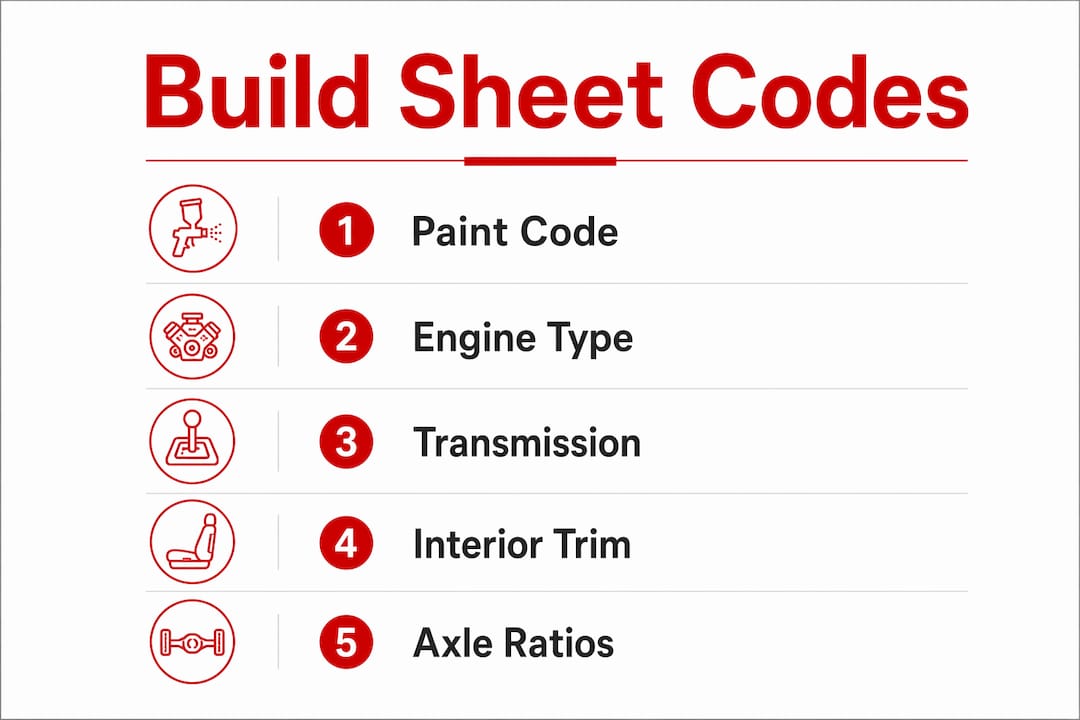
Build sheets include codes for factory options such as paint, engine type, transmission, axle ratios, interior trims, and unique production sequence numbers. These codes require manufacturer-specific decoding guides to interpret accurately. A code that means “four-speed manual” on one platform means something entirely different on another.
The sheet is typically organized into sections. Engine and drivetrain codes appear in one block. Paint and exterior codes occupy another. Interior trim, optional equipment, and production sequence data fill the remaining sections. The layout varies by manufacturer and model year, which is why cross-referencing with marque-specific resources is necessary.
Common abbreviations include “CC” for custom color codes and “EO” for engine options, both of which are key to verifying factory features. Recognizing these codes is what separates an informed buyer from one who takes a seller’s word at face value.
| Code Category | What It Represents | Why It Matters |
|---|---|---|
| Paint code | Factory exterior color designation | Confirms original color vs. repaint |
| Engine code | Displacement, configuration, output rating | Verifies matching-numbers status |
| Transmission code | Gearbox type and ratio | Confirms factory drivetrain pairing |
| Axle ratio code | Rear differential gearing | Critical for performance verification |
| Interior trim code | Upholstery material and color | Validates original cabin specification |
| Option/package code | Factory-installed equipment bundles | Distinguishes factory from dealer add-ons |
Pro Tip: Cross-reference every build sheet code against the vehicle’s VIN using the NHTSA VIN decoder tool. The 11th VIN character identifies the specific assembly plant, which should match the plant code on the build sheet. A mismatch is a serious red flag.
Why do build sheets matter for authenticity and value?
Build sheets are essential for verifying authenticity and matching-numbers status, with properly documented factory paperwork materially increasing collector vehicle market value. “Matching numbers” means the engine, transmission, and other major components carry the codes that the build sheet says they should. Without the build sheet, that claim is unverifiable.
Fraud in the collector car market is not rare. Sellers swap engines, repaint cars in more desirable colors, and add options that were never factory-installed. A build sheet makes those substitutions visible. It is the document that separates a genuine barn find from a well-constructed story.
The benefits of owning an original build sheet extend well beyond fraud prevention:
- Provenance verification: Confirms the vehicle’s factory configuration without relying on seller testimony.
- Restoration accuracy: Identifies the correct paint codes, trim materials, and mechanical specifications for period-correct rebuilds.
- Parts ordering precision: Reveals the exact “as-built” configuration, avoiding mistakes based on general model-year assumptions.
- Market value protection: Documented provenance commands a premium in the vintage vehicle market.
- Insurance and appraisal support: Appraisers use build sheets to establish agreed value for collector vehicle policies.
Pro Tip: Treat a missing build sheet as a red flag when purchasing any collector vehicle. Experienced collectors view missing original documentation as a significant gap in provenance, not a minor inconvenience.
How does a build sheet differ from a window sticker?
A window sticker, formally called a Monroney label, is a consumer-facing document required by federal law on new vehicles. It lists the MSRP, standard features, optional equipment, and fuel economy ratings in plain language. A build sheet is a technical, internal document filled with raw option codes and production sequence data that was never intended for the buyer.
Build sheets and window stickers serve different roles: build sheets contain raw factory codes and internal production sequences, while window stickers are sanitized, consumer-facing labels showing prices and options. The window sticker translates factory codes into readable descriptions. The build sheet is the source document those descriptions are drawn from.
| Feature | Build Sheet | Window Sticker (Monroney) |
|---|---|---|
| Intended audience | Assembly line technicians | Retail buyers |
| Language | Manufacturer-specific codes | Plain English descriptions |
| Includes pricing | No | Yes (MSRP and option costs) |
| Legal requirement | No | Yes, under federal law |
| Provenance value | High | Moderate |
| Useful for restoration | Yes | Limited |
Cross-referencing both documents is the most reliable way to detect non-factory modifications. If the window sticker lists a specific engine but the build sheet codes point to a different configuration, something changed after the car left the factory. That discrepancy is worth investigating before any money changes hands.
How to find and use a vehicle build sheet in 2026
The 17-character VIN, standardized by NHTSA from 1981 onward, is the starting point for any build sheet request. For post-1981 vehicles, owners can contact the manufacturer’s customer service or heritage department directly. Many manufacturers maintain archived build data and will issue a formal heritage certificate or build record upon request, typically requiring proof of ownership.
For vehicles made before 1981, VIN formats are not standardized, requiring use of marque registries, club archives, or manufacturer history departments to obtain build documentation. This process can take weeks or months and often requires proof of ownership. Patience is not optional for pre-1981 research.
Sources for obtaining a build sheet, organized by vehicle age:
- Post-1981 vehicles: Contact the manufacturer’s heritage or customer relations department directly using the VIN.
- Classic and muscle cars: Reach out to marque-specific registries and owner clubs, which often maintain archived build data.
- Rare or limited-production models: Seek out manufacturer archives or specialist documentation services that focus on specific marques.
- Vehicles with lost paperwork: Check under carpets, behind door panels, and in the trunk area. Physical build sheets were sometimes tucked into the car during assembly and occasionally survive decades later.
Original physical build sheets are often lost or discarded during assembly, making digital factory records and heritage certificates the most reliable modern alternative. A digital record from the manufacturer carries the same evidentiary weight as a physical sheet and is far less likely to be damaged or forged. In 2026, serious buyers should prioritize these authenticated digital records over generic third-party history reports that lack component-level detail.
Key Takeaways
A vehicle build sheet is the definitive factory record that verifies a vehicle’s original specifications, protects its market value, and guides accurate restoration work.
| Point | Details |
|---|---|
| Core definition | A build sheet is the internal factory document tied to a vehicle’s VIN, recording every assembly specification. |
| Code interpretation | Manufacturer-specific codes for paint, engine, and trim require decoding guides to read accurately. |
| Authenticity tool | Build sheets verify matching-numbers status and expose non-factory modifications before purchase. |
| Build sheet vs. sticker | Window stickers are consumer-facing price labels; build sheets are technical production records with higher provenance value. |
| How to obtain one | Contact the manufacturer’s heritage department with your VIN, or use marque registries for pre-1981 vehicles. |
The document most buyers overlook until it’s too late
The collector car market has a documentation problem, and most buyers only discover it after the sale closes. Generic vehicle history reports have become the default due diligence tool, and they are genuinely useful for tracking accidents and title changes. What they cannot do is tell you whether the engine in the car is the one the factory installed. That requires a build sheet.
The shift toward digital heritage certificates is one of the most positive developments in collector car buying in recent years. Manufacturers that maintain searchable archives give buyers a level of confidence that simply was not available a decade ago. The challenge is that not every buyer knows to ask for this documentation, and not every seller volunteers it.
My honest observation after years of working alongside restoration specialists and collectors: the vehicles that command the strongest prices and the most confident buyers are always the ones with complete factory documentation. A bespoke restomod built on a verified, documented platform is worth materially more than an identical-looking vehicle with a murky paper trail. The build sheet is not a formality. It is craftsmanship as currency.
For anyone considering a classic vehicle purchase or a ground-up restoration, treat the build sheet as a non-negotiable starting point. The benefits of owning classic vehicles are amplified significantly when the provenance is airtight.
— Evolve
Precision restoration starts with the right documentation
Factory documentation is the foundation of every great restoration. At Ecdautodesign, every bespoke Land Rover Defender build begins with a meticulous understanding of the vehicle’s original specifications, ensuring that every customization decision is informed by what the factory intended.
Ecdautodesign’s custom restoration approach treats factory records as the blueprint for everything that follows, from drivetrain selection to interior finish. When you know exactly what a vehicle was built to be, you can make deliberate, confident choices about what it should become. Explore how Ecdautodesign’s expert restoration process preserves heritage while delivering the performance and luxury that modern collectors demand.
FAQ
What is a vehicle build sheet used for?
A vehicle build sheet is used to verify a vehicle’s original factory specifications, confirm matching-numbers status, and guide accurate restoration work. It is the primary document for establishing provenance in the collector car market.
Where can I find a vehicle build sheet?
For post-1981 vehicles, contact the manufacturer’s heritage or customer relations department using your 17-character VIN. For older vehicles, marque registries and manufacturer archives are the most reliable sources.
How does a build sheet differ from a vehicle history report?
A build sheet records factory-level specifications including engine codes, paint codes, and trim options. A vehicle history report tracks ownership, accidents, and title changes but contains no component-level factory data.
What does “matching numbers” mean in relation to a build sheet?
“Matching numbers” means the major components in a vehicle, particularly the engine and transmission, carry the codes that the original build sheet specifies. A build sheet is the document that makes this verification possible.
Can a build sheet increase a vehicle’s market value?
Properly documented factory paperwork materially increases collector vehicle market value. Authenticated build records give buyers confidence in a vehicle’s originality, which directly supports stronger sale prices.
Recommended
- Classic SUV Build Specification Checklist: 2026 Guide
- Behind the Bay: Drivetrain Assembly at ECD Automotive Design – Custom Defender | Restored Defender Specialists | ECD Auto Design
- Barrons | The Six-Figure Cars Drawing Enthusiastic Women Buyers – ECD Auto Design
- Everything You Need to Know About Buying a Used Defender – Custom Defender | Restored Defender Specialists | ECD Auto Design
FREQUENTLY ASKED
QUESTIONS
No FAQs configured yet.